









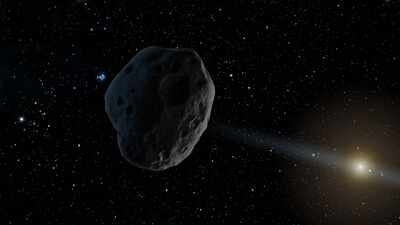
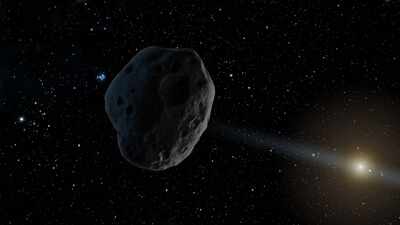
The scientific community believed for almost three decades that a tiny celestial body moving around Earth belonged to the category of asteroids. But a study conducted recently by NASA has shown that this space body had been hiding a shocking secret from scientists, it is actually a comet.According to reports appearing in the journal Nature Astronomy, this discovery is the outcome of an extensive research work carried out internationally and headed by scientists from NASA’s Jet Propulsion Laboratory located in Southern California. Apart from changing the status of this space object, this discovery will provide additional information for identifying possible dangers in outer space.This object which was till now referred to as 1998 SH2 had first been discovered in 1998. It has so far been classified as a near-Earth asteroid, which moves around the Sun once every four and a half years. During its last pass-by in August 2025, when it came within 3 million kilometers from the Earth, researchers spotted something strange.Whereas this normally results in the development of the typical luminous tail as well as a glowing cloud around comets, 1998 SH2 was observed to be unusually calm. The escape rate of gas and dust from its surface was so minimal that previous observations had not been able to see any sign of activity.Important observationsIn order to prove their idea, scientists sought the aid of some of the world’s most advanced observatories, including the Canada-France-Hawaii Telescope and the European Southern Observatory’s Very Large Telescope located in Chile. Through the highly sensitive observations, scientists were finally able to identify the object’s weak tail, which proved that the body was a comet, not an asteroid.Since then, the object has been reclassified to be known as the comet P/1998 SH2.The finding also bears much significance in terms of planetary defence. Scientists have suggested that there could be more objects in our Solar System that have been misclassified due to the absence or faint appearance of their comet activity. This includes members of a special class called dark comets – celestial bodies that exhibit comet activity without being able to produce the characteristic comet tail.According to scientists, tracking the orbits of near-Earth objects and studying the variations in them can help to see the impact of outgassing and detect asteroids from hidden comets. The distinction is crucial since the orbital characteristics of comets may slightly differ from those of asteroids and can affect the evaluation of their trajectory and possible impact.In this context, NASA’s upcoming Near-Earth Object Surveyor mission aimed at the search of hard-to-detect asteroids and comets is expected to prove itself useful. The recent finding clearly shows that improvements in the field of telescopes and precision tracking techniques keep shaping the views of scientists about our solar system, showing that there is always something surprising about well-known celestial bodies.