







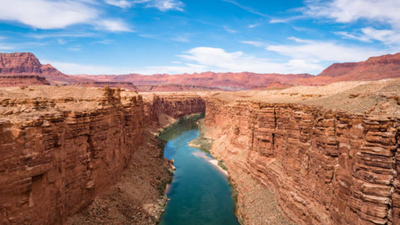
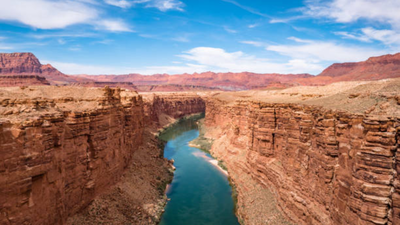
About 40 million people depend on the Colorado River system across the United States and Mexico. From drinking water to municipal needs and even agricultural irrigation, both countries depend on the river and have shared and formally managed its water under a binational agreement for over 80 years. They signed the 1944 Water Treaty, where US guaranteed Mexico an annual delivery of 1.5 million acre-feet of water under normal conditions.But recently, water officials from US and Mexico signed a new agreement for sharing the Colorado River where Mexico agreed to take less water from the river under a new deal. Expert onlookers are heralding the deal as a success and a rare example of cross-border collaboration. They said the cuts are necessary in response to a severely depleted Colorado River.The river which starts in the snowy peaks of the Rocky Mountains, once met the Pacific Ocean on the Mexican coast. But since the 1960s, it has rarely reached the sea due to extensive water use by cities and farms throughout the American Southwest.
A tweaked treaty
Interestingly, this is not the first time that the treaty has been tweaked. The two nations have previously also shifted the amount of water shared between them. A previous agreement from 2017 will expire at the end of this year. The new one will be in effect from the beginning of 2027 to the end of 2028.From this term, Mexico will take larger cuts than it has in the past. The new deal reduces the country’s share of the river by 250,000 acre-feet, about 17% of its original allocation from the Colorado River.The new agreement is being celebrated on both sides of the river border. According to Jennifer Pitt, Colorado River programs director at US-based nonprofit conservation group National Audubon Society, Mexico agreeing to reduce its water has widespread benefits.Pitt said she was “extremely pleased” to see that the agreement was decided on its own without being complicated by “any of the other broader geopolitical issues that can be present in diplomatic relations.” The agreement was forged through meetings of the International Boundary and Water Commission, a special agency founded in 1889 to manage the Rio Grande and Colorado River.“I think that’s remarkable,” she said. “Particularly at this moment on the Colorado River, where there are so many disagreements and so much uncertainty. The fact that the United States and Mexico are still able to reach these agreements is important and really beneficial to all water users.”Carlos de La Parra, managing partner of Mexico-based Luken Centre for Strategies on Water and Environment, said the “institutional design” of cross-border water negotiations has been key to its success. By spending lots of time together and making in-person visits to water infrastructure in both countries, he said, negotiators are better able to see eye-to-eye.“You don’t discover this sitting behind a desk in Washington, D.C., or Mexico City,” de la Parra said. “You discover it by being right at the border and by really talking across the border to your counterpart in the commission.”De la Parra, who has served as an informal advisor to Mexico’s negotiators for about 15 years, said the successes in the Colorado River space could have lessons beyond water management. “I really believe that there’s a model there that has a lot to provide for U.S.-Mexico relations in other realms,” he said.
Restoring the ecosystem
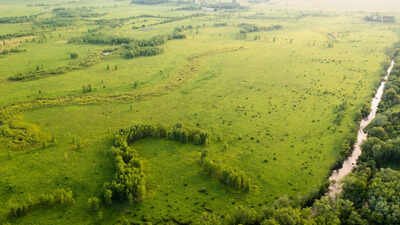
In itself, the Colorado River Delta is also home to a major environmental restoration effort. A coalition of environmental groups, including those associated with Pitt and de la Parra, has been methodically using small amounts of water to regrow little islands of green in the middle of that desert.Their work, largely designed to provide crucial habitat for migrating birds, will not receive water through the new agreement. However, leaders of the Raise the River Coalition said they have already secured the water necessary to continue their restoration work, and the new agreement “reflects a responsible, forward-looking response to a drier basin, while preserving the framework for environmental cooperation that has contributed to the restoration of the Colorado River Delta over the past decade.““Raise the River’s own water holdings — secured over more than a decade of investment — remain sufficient to sustain the restoration sites developed in partnership with the United States and Mexico since 2012,” the coalition’s leaders wrote in a press release.In June, a new study found that the restoration efforts have resulted in the planting of more than 250,000 trees across nearly 1,400 acres of riparian habitat. A co-author of the study said it showed how “a little bit of water can go a long way” in the Colorado River delta.
US in a tussle
In US, states have been fighting back and forth over sharing the Colorado River amongst themselves. Years of negotiations failed to produce an agreement between them, and the federal government was forced to come up with a new water-sharing plan on its own. That plan is controversial and may trigger lawsuits that would further complicate water management.Pitt, whose work has long involved environmental projects in Mexico’s Colorado River delta, said the new binational deal gives Mexican water users some stability as U.S. states sort out their differences.“Many water users are going to be experiencing discomfort and pain because of a reduced water supply,” she said. “But I think it provides them with the security of knowing exactly what the rules of the game are. They have the certainty of knowing what their water supply will be. They are able to plan around that.”