








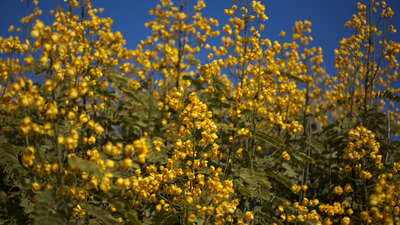
Back in the 80s, Kerala’s forest department planted a few Senna spectabilis trees around a forest office and along roadsides in Wayanad, simply looking for something that would grow quickly and provide shade. The tree is native to tropical America and known for its bright, beautiful yellow blooms, and it seemed harmless enough at the time.Only until it wasn’t.Senna had already colonised parts of Africa, Asia and Australia before it ever reached Wayanad, and it went on to spread silently until the damage was impossible to ignore.
How Senna plants with beautiful yellow flowers became one of the most problematic invasive species
Senna spectabilis was planted in Wayanad purely as a fast-growing tree to provide shade near forest offices and roads. What went unnoticed was its track record in other parts of the world, where it had already established itself as a serious invasive species in parts of Africa, Asia and Australia. Kerala’s forest department didn’t recognise the plant as invasive until 2011, a full 25 years after the first saplings went into the ground, by which point it had already spread widely across the sanctuary.
The tree quietly took over Wayanad’s forests
Once established, Senna spread with a momentum that’s hard to reverse. Researcher P.A. Vinayan’s mapping shows its footprint in Wayanad Wildlife Sanctuary grew from under 16 square kilometres in 2013-14 to nearly 124 square kilometres by the most recent survey, an almost eightfold increase in a decade that now covers roughly 35% of the sanctuary’s total area. Forest officials link the surge partly to a bamboo die-off around 2012, which opened up space that Senna moved into before bamboo could recover.
Elephants and deer became unwitting accomplices
Senna’s spread wasn’t accidental; a 2021 study led by researcher Anoop N.R. found that Asian elephants, chital, and Indian crested porcupines all disperse Senna seeds through their dung, with a single elephant dropping found to contain around 2,000 seeds. Because Senna fruits in summer, exactly when elephant numbers in Wayanad swell with seasonal migration from across the Nilgiri Biosphere Reserve, the timing also supports the invasive tree’s spread.
How does this impact the ecosystem of Wayanad?
Senna’s dense canopy shuts out sunlight, and as its leaves pile up and rot on the forest floor, they seem to change the soil in ways that make it tough for other plants to grow there. Studies have shown that it also affects the biodiversity of the area, including Butterflies, that are also impacted since they lose the specific plants they depend on to lay their eggs. Even the animals that eat a bit of Senna barely get anything out of it nutritionally. And it’s not just wildlife that pays the price; tribal communities who’ve long depended on the forest for food like gooseberries, wild tubers and mushrooms are watching those supplies quietly disappear wherever Senna grows.
Efforts to remove Senna are underway
Forest departments across the three states, including Karnataka and Tamil Nadu, where it has spread, have tried girdling, debarking and manual uprooting to control Senna, with inconsistent results. Early debarking trials in Wayanad killed only a small share of treated trees and often triggered vigorous regrowth from the cut stumps.