









Most people, asked whether they fear death, either dodge the question or answer with something solemn. Winston Churchill did neither. “I am prepared to meet my Maker,” he said. “Whether my Maker is prepared for the great ordeal of meeting me is another matter.” It is one of the most quoted lines ever said about mortality, and almost none of the usual gravity attached to the subject survives it. Churchill takes the biggest, most unavoidable fact of life and turns it into a joke at his own expense, without ever actually denying how serious the subject is. The line has outlived him by decades precisely because it manages both things at once, honesty and humour, in a single sentence most people would need a full paragraph to attempt.
Who was Winston Churchill
Churchill led Britain through the Second World War as prime minister, and remains one of the most widely quoted political figures of the twentieth century, known as much for his wit as for his wartime leadership. He made this particular remark around his eightieth birthday, in late 1954, at a press conference in Washington, by which point he had already survived two terms in Downing Street, several serious illnesses, and decades of public scrutiny few politicians ever face.By that stage of his life, Churchill had earned a reputation for turning nearly any subject, however serious, into an opportunity for a memorable line. Journalists expected wit from him almost as a matter of course, and questions about ageing or mortality, which most public figures would have answered cautiously, gave him exactly the kind of opening he tended to enjoy most.His health by 1954 was already a matter of public speculation. He had suffered a serious stroke the previous year, largely concealed from the public at the time, and had spent decades battling recurring bouts of pneumonia and depression he privately called his “black dog.” None of that stopped him from framing his own mortality, in public, as a subject for comedy rather than concern, which is part of why the remark carried more weight coming from him than it would have from a younger, healthier man simply being glib.
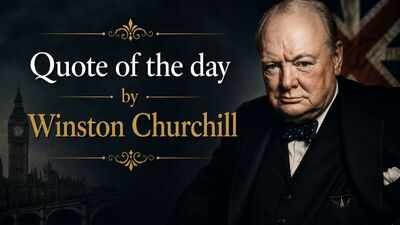
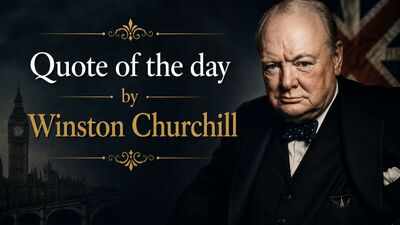
Quote of the day by Winston Churchill
“I am prepared to meet my Maker. Whether my Maker is prepared for the great ordeal of meeting me is another matter.”
Understand the meaning of the quote by Winston Churchill
The joke works because it reverses an assumption almost everyone makes automatically. Facing death, the natural question is whether you are ready for what comes next. Churchill answers that question instantly and confidently, then flips the entire frame around, suggesting the more interesting uncertainty is not his own readiness but whether the universe itself is ready for him.Underneath the joke sits a genuine kind of confidence. Most people who claim to be at peace with death say so quietly, almost apologetically. Churchill says it with the same swagger he brought to everything else, treating even his own mortality as material for a good line rather than a subject that had to be handled with permanent solemnity.
Churchill’s lifelong habit of laughing at serious things
This was not a one-off performance for a reporter’s benefit. Churchill built an entire public persona around finding the joke inside the gravest situations, from wartime speeches that mixed defiance with dry humour to parliamentary exchanges where his sharpest lines often landed hardest precisely because they were funny. He once responded to a political rival’s insult by saying he would be happy to explain the difference between the two of them to her when she had sobered up, and remarks in that same register, sharp, unbothered, and quotable, followed him through most of his public life.That habit extended naturally to how he talked about his own decline. Rather than avoiding questions about age and mortality as he grew older, he leaned into them, using the same comic instinct that had carried him through decades of political combat. The Maker quote is really just a particularly polished example of a lifelong pattern rather than an exception to it.Even his own funeral arrangements, planned in detail years before his death in 1965, reportedly included instructions consistent with that same instinct, a state occasion grand enough to match his sense of his own historical importance, delivered with the kind of theatrical flourish he had brought to nearly everything else in public life. Churchill did not treat death as a subject to be handled quietly once he was gone. He treated it, right up to the end, as one more stage to perform on.
Why humour about death is not the same as denial
It would be easy to mistake this kind of joke for avoidance, a way of dodging an uncomfortable subject by making light of it. Churchill’s version does something different. The joke only lands because he has already stated, plainly, that he is prepared. The humour comes afterward, layered on top of an admission most people struggle to make sincerely at all.This is a useful distinction to hold onto more generally. Genuine humour about a difficult subject usually requires facing the subject honestly first. A joke used to dodge a hard truth tends to feel hollow, because the truth is still being avoided underneath it. A joke used after the hard truth has already been stated plainly, the way Churchill’s is, tends to land as confidence rather than evasion.The order of the two halves of the sentence is what makes this work. Reverse them, joke first and admission second, and the line loses almost all of its force, reading as flippant rather than composed. Said in the order Churchill actually used, the acknowledgement of death comes first, settled and unhurried, before the joke is allowed to follow. That sequencing is not accidental. It is what separates wit from avoidance in almost any difficult conversation, not just this one.
How to apply this quote by Winston Churchill in daily life
You do not need to be facing your own mortality to borrow something useful from this quote. Most people carry at least one subject they find too heavy to discuss honestly, a health worry, a professional failure, a fear about the future, and default to either avoiding it entirely or discussing it with excessive solemnity that makes everyone around them uncomfortable.Churchill’s approach suggests a third option. Say the hard thing plainly first. Only then, once it has actually been acknowledged rather than skirted around, does a lighter tone become available without it feeling like avoidance. Trying to reach for the joke before the honest admission usually backfires. Reaching for it afterward, the way Churchill does here, tends to put people at ease rather than unsettle them further.
Other famous quotes by Winston Churchill
- “Success is not final, failure is not fatal: it is the courage to continue that counts.”
- “We make a living by what we get, but we make a life by what we give.”
- “If you’re going through hell, keep going.”
- “A pessimist sees the difficulty in every opportunity. An optimist sees the opportunity in every difficulty.”