









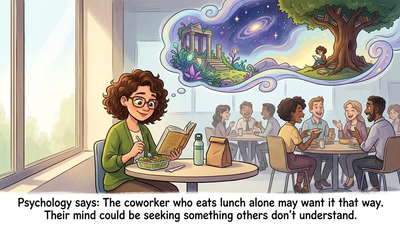
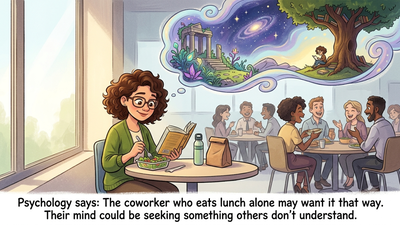
There is usually one person in every office who picks up their lunch, walks away from the noisy table and finds a quiet corner. While everyone else is exchanging gossip, discussing the boss or laughing over something that happened in the morning meeting, this coworker is perfectly comfortable eating alone.And that can be surprisingly easy to misread. The empty chair beside them may look like loneliness from the outside. But sometimes, they have deliberately chosen that chair.Also Read: Husband loses Oracle job after 12 years; wife’s emotional LinkedIn post about his dedication wins heartsPsychology suggests that eating alone can have very different meanings depending on the person and the situation. For some employees, lunch is not another opportunity to socialise. It is the only part of the workday when nobody is asking a question, assigning a task or expecting a response.Lunch can be the one part of the day that belongs to youA 2024 study published in Sociology examined how people organise and experience the workday lunch through in-depth interviews with 21 workers in England. The researchers found that lunch is shaped not only by food but also by workplace routines, social expectations and the need to separate eating from working. The study also found that some workers actively sought solitude during lunch even when colleagues were around. In some cases, people used a phone or another cue to signal that they wanted to be left alone.That makes the office lunch table more complicated than it appears.Someone sitting alone may not be thinking, Nobody wants to sit with me. They may simply be thinking, I finally have 30 minutes to myself.
How do you feel about eating lunch alone at work?
3k+ users shared opinion today
5k+ users already voted today
3k+ users shared opinion today
The surprising part: being alone and being lonely are not the sameLoneliness is about feeling disconnected or lacking meaningful social relationships. Solitude, on the other hand, can be something a person actively chooses because they enjoy having uninterrupted time.Recent research on solo dining also shows why it is difficult to attach one psychological meaning to eating alone. A 2026 study in the International Journal of Psychology found that solo dining can have mixed motivations. The researchers examined links between solo dining, loneliness and social anxiety and concluded that eating alone can reflect different pathways rather than one simple psychological state.So the colleague eating alone may be lonely. They may also be perfectly content. The lunch itself does not tell you which one it is.Why office lunch can feel different from lunch outside workThere is another reason some employees may prefer eating alone at work: office lunch is still connected to the office.Even when the laptop is closed, the people around the table are still colleagues. A casual lunch can quickly turn into a conversation about deadlines, a manager, a promotion, a difficult client or someone’s salary.For someone who spends eight or nine hours navigating workplace relationships, a quiet meal can therefore feel less like isolation and more like a reset.
What’s the main reason you prefer to eat alone?
3k+ users shared opinion today
5k+ users already voted today
3k+ users shared opinion today
And office culture can make solo lunch look stranger than it isThe idea that everyone should eat together is not universal.The Guardian recently looked at the growing number of workers choosing to eat lunch alone, highlighting a generational divide in France and reporting that 29% of French workers under 25 regularly ate lunch alone, compared with 12% of workers over 49. The article also cited research indicating that 84% of UK workers often, always or sometimes eat lunch alone.In other words, the solitary lunch is hardly an unusual workplace behaviour.What changes is how the office interprets it.One person may see an empty lunch seat and think, Why doesn’t anyone sit with them?The person sitting there may simply think, This is my favourite 30 minutes of the day.And that is perhaps the part coworkers don’t always understand: choosing to eat alone can sometimes be less about avoiding people and more about choosing what to do with a rare piece of personal time.Still, eating alone should not automatically be romanticised either. If someone wants company but consistently feels excluded, the same behaviour can have a very different meaning. Research has found associations between unwanted solitary eating and loneliness, showing why the person’s own experience matters more than what the lunch table looks like from across the room.So next time you see that coworker quietly eating alone, there may be no mystery to solve.They may simply have chosen the one part of the workday when nobody gets to choose for them.