









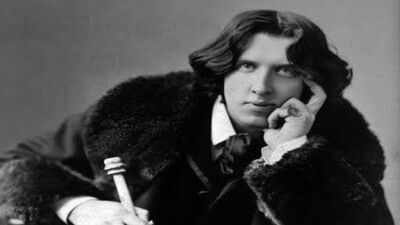
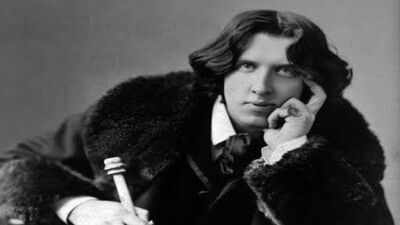
Oscar Wilde, the Irish writer born in Dublin who became famous for being the face of the Aesthetic Movement in 1881, which spearheaded the appreciation of art for the sake of art during the Victorian era.Producer Richard D’Oyly Carte invited Wilde to tour America, to give lectures. Wilde, who was then 27, sailed from Liverpool, and the ship reached New York late and waited in quarantine overnight. The next morning it docked, and passengers headed to the customs shed at Castle Garden, then the main entry point for visitors to the city. His first lecture, at Chickering Hall, followed on January 9.This is where the famous story begins. Customs officers asked arriving travellers whether they had anything to declare, meaning goods that might be taxed. It was a routine question.It is here that Wilde said his most quoted words.But whether he actually said it or not has been a topic of discussion for years.Let’s find out what exactly happened.Some sentences are so perfectly framed that we assume they came straight from a genius. We imagine a famous person, a perfect moment, and that one reply. Then the line goes onto mugs, posters and social media, and nobody asks where it came from.Over the years, these clever remarks get passed down through generations, with their own improvisations over time, and slowly get attributed to the name of whoever seems most likely to have said them.Oscar Wilde’s words are perhaps the best example.
Did Oscar Wilde really say “I have nothing to declare except my genius “?
According to Harvard University Press, Wilde was 27 when he arrived at the port of New York in 1882, at the start of an eleven-month speaking tour of America. Historian Roy Morris Jr. writes in his book Declaring His Genius that it was the morning of January 3. Wilde supposedly told a customs officer who asked if he had anything to declare, “I have nothing to declare except my genius.”Just by reading through, it is quite simple to understand why this line became so famous. Thousands of books of quotations and websites repeat it, making it one of Wilde’s best-known utterances.But then, Morris says nobody on the scene recorded the remark at the time, “No one actually heard him say it, but it sounded like something Wilde would have said, and by the time literary biographer Arthur Ransome quoted it first in his 1912 study of the author, the quip already had passed into legend.”According to his explanation, the remark sounded so much like Wilde that it was believed anyway. Biographer Arthur Ransome mentioned it in a 1912 study, “Oscar Wilde: A Critical Study”.But it is important to understand that Ransome did not use quotation marks. He only wrote that Wilde told customs officials he had nothing to declare but his genius.The book contained the following anecdote, “That is how it came about that on December 24, 1881, Wilde sailed for New York, to say that he was disappointed in the Atlantic, to tell the Customs Officials that he had nothing to declare except his genius, and to lecture throughout America on “The English Renaissance of Art,” “House Decoration,” and “Art and the Handicraftsman”.”John Cooper, who runs the website Oscar Wilde in America, has studied the question closely. According to This Day in Quotes report, Cooper points out that Ransome and Frank Harris, Wilde’s friend, both wrote more than a decade after Wilde’s death in 1900, and that there is no known record of the quote in anything written while Wilde was alive. Based on his research, Cooper calls it a “dubious quotation.”
So, does that mean Wilde never said it?
Well, not necessarily. A missing record is not proof, because it only means nobody can show that he did. So, whether or not Wilde may have said these words, it is no less than a legend, it may be true, but it is certainly unproven, and, as Morris described, nevertheless, the tour marked the beginning of the modern cult of celebrity.Disclaimer: The information given in this article is based on information available through online platforms at the time of writing the piece; some details, especially older stories and quotes, may differ from source to source or change over time. This article is only meant for general information purposes only.