








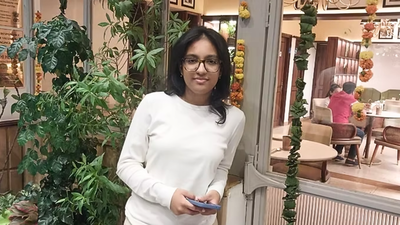
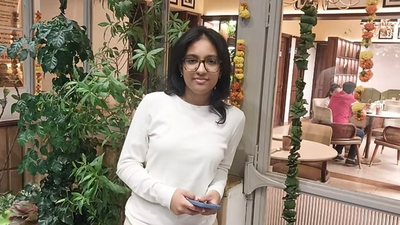
A school trip to Delhi’s Sundar Nursery in 2023 left 17-year-old Mahi Malhani thinking about something beyond the park’s gardens and restored monuments. She noticed plastic wrappers, bottles and food waste scattered on the ground, sometimes just a few steps away from dustbins. The sight raised a question to her. Why was litter still lying around when bins were readily available?Rather than seeing it only as a problem of public behaviour, the Delhi student began thinking about how technology could make waste disposal easier. That question eventually led her to develop TRASHbot, an artificial intelligence-powered robot designed to detect, collect and sort waste. According to the official website of Take Care International Foundation, the robot can sort waste with nearly 90% accuracy and is now being tested in homes, schools and residential communities.Mahi’s idea was based on a simple observation. Having dustbins nearby does not necessarily mean people will use them. She wanted to create something that could make responsible disposal more convenient.
How a school trip led to TRASHbot
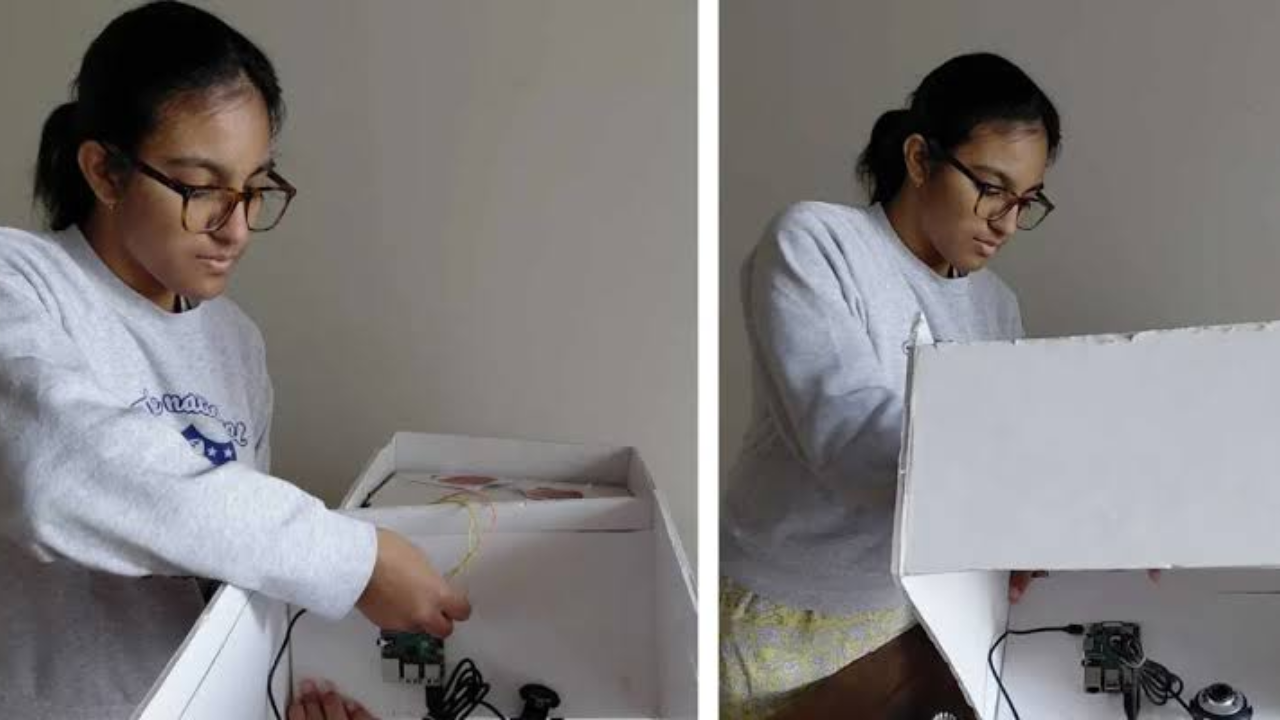
Mahi began exploring how robotics and artificial intelligence could be used to address the problem. She spent months researching waste management systems, sketching designs and studying how autonomous robots work.Her interest in technology had started much earlier. According to Take Care International Foundation, she had experimented with programming languages such as Python, C++ and JavaScript and often took apart old electronic devices to understand how they worked. Over time, her interest moved from writing code to building machines that could perform practical tasks.She later joined a summer robotics programme at Rancho Labs, an IIT Delhi-based robotics and Internet of Things initiative, where she received technical guidance from mentors. Her school computer teacher also helped refine the project. Take Care International Foundation reports that Mahi continued to develop the prototype independently, with the idea and its execution remaining her own.
How does the AI-powered robot work?
The robot also uses ultrasonic sensors to detect obstacles and avoid collisions.
TRASHbot is designed to do more than function as a conventional dustbin. It can move around, detect waste, collect it and direct it into the appropriate compartment. As reported by The Economic Times, the robot uses a camera and an artificial intelligence model called YOLOv3 to identify waste. The images captured by the camera are processed using a Raspberry Pi, while an Arduino Uno controls the robot’s movement. It classifies waste into biodegradable and non-biodegradable categories and uses motors to direct the material into the correct compartment.The robot also uses ultrasonic sensors to detect obstacles and avoid collisions. It can operate autonomously or be controlled through a smartphone application. The reported performance figures distinguish between its different functions. TRASHbot identifies waste correctly about 85% of the time, sorts it accurately in 90% of cases and avoids obstacles with a reported 98% success rate.
From home trials to schools and residential communities
The robot was first tested at Mahi’s home and later in her school’s cafeteria, where it was used to collect wrappers during busy hours. TRASHbot had also been used in two residential societies in Noida and by a municipal corporation in Udaipur since March 2025. These trials allowed Mahi to see how the robot performed outside controlled demonstrations and in places where people dispose of different kinds of waste.
Recognition and plans for the future
TRASHbot has also received recognition in student innovation competitions. The Atal Innovation Mission’s official list of the top 100 entries in the ATL Tinkerpreneur 2025 programme includes Mahi Malhani as an individual participant from Amity International School, Mayur Vihar, Delhi, with TRASHbot listed as her project.Mahi wants to expand the robot’s waste-sorting capabilities. While it currently separates biodegradable and non-biodegradable waste, future versions could identify five categories: plastic, metal, glass, biodegradable and non-biodegradable waste. She is also considering cloud connectivity and solar-powered charging.The aim, as she has described it, is to make the robot useful beyond urban settings. Rural areas can present different challenges, including rough terrain and fewer facilities, and she wants future versions to work in those conditions as well.