








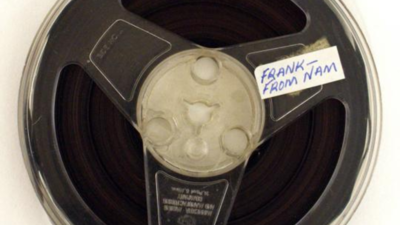
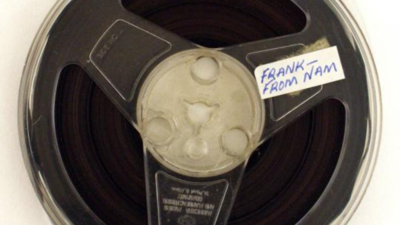
In March 1969, a 21-year-old American soldier stationed in Vietnam decided to do something different from writing a letter home. Frank A. Kowalczyk switched on a reel-to-reel tape recorder and began speaking to his mother in Illinois, sharing updates about his fellow soldiers, life in the Army, family gossip and his plans for the future. During the approximately 43-minute recording, he spoke more than 8,600 words, while the sound of a helicopter passing overhead captured the reality of a war thousands of miles from home. Fifty-seven years later, the recording is preserved by the Smithsonian’s National Postal Museum in Washington, DC.Kowalczyk, a US Army private first class from the Chicago area, was serving with Headquarters, 46th Engineers Battalion, 20th Brigade, at Long Binh Post near Saigon. He had bought the recording machine from another soldier and preferred speaking into a microphone to putting his thoughts on paper.“I figured I’d just sit down and instead of writing you a letter just make use of tape,” he said at the beginning of the recording, explaining that it would be easier because he hated writing. The museum’s catalogue describes the message as having been recorded over several sessions in March 1969. While Smithsonian Magazine describes it as a 43-minute tape, the National Postal Museum’s object record rounds its duration to approximately 45 minutes.What followed was not a carefully prepared account of military service, but a long, informal conversation with his family back home in Calumet City, Illinois.From family gossip to the realities of warKowalczyk’s recording moved between the ordinary details of life and the unsettling circumstances surrounding him. He asked his mother about his father’s work schedule, checked on his siblings and wondered whether neighbours back home had married. He also discussed his friends, his experiences in the Army and his frustration with the routine duties imposed on soldiers at Long Binh Post.The everyday questions gave the recording an intimacy that a formal account of military life might have lacked. He was not simply documenting his deployment; he was trying to remain part of the family life continuing without him.He also talked about the differences between life in Vietnam and the world he had left behind. He described the military routine, the weather, the food and his experiences travelling around Saigon and nearby places. He mentioned learning Vietnamese and joked about how difficult it might be to stop using the language after returning home.Yet the recording also contained glimpses of the war’s harsher realities. Kowalczyk referred to a fellow soldier who had bled to death in a bunker because help had not arrived. He expressed a preference for being assigned outside the main base, where he felt soldiers were treated with greater respect.The conversation was not a polished historical account, and its value lies partly in that informality. His remarks captured the concerns, frustrations and familiar routines of a young man trying to make sense of military life while staying connected to people he missed.
The helicopter that brought the war into the room
One of the most striking moments comes when Kowalczyk draws his mother’s attention to a helicopter flying overhead. “Right now in the background, you’ll probably hear a chopper flying over,” he says in the recording. He goes on to explain that helicopters passed over the area frequently throughout the day.For his daughter, Manda Kowalczyk, the sound has become one of the recording’s most powerful elements. Speaking to Smithsonian Magazine, she explained that the helicopter was a reminder of the distance between her father’s home and the place where he was serving. “These helicopters are not in Chicago. This is happening in Vietnam,” she said.Lynn Heidelbaugh, a curator at the National Postal Museum, similarly highlighted what the recording preserves beyond its spoken words. The helicopter’s noise is something a written letter could not convey, giving listeners a sense of the environment surrounding the soldier as he spoke.Kowalczyk also asked his mother to record a reply and send it back with news, weather reports or television audio. Hearing familiar sounds from home, he suggested, would be strange in the best possible way because such material was rarely available to him in Vietnam.
How audio letters connected soldiers with home
Audio correspondence had become a way for military personnel and their families to exchange more personal messages during periods of separation. By the Vietnam War era, reel-to-reel recorders were increasingly accessible, allowing some service members to record their own tapes.The American Red Cross also operated recording facilities in Vietnam and the Pacific, while its “Voices from Home” programme helped families record messages for relatives serving overseas. Such recordings allowed loved ones to hear familiar voices rather than relying exclusively on handwritten letters.Military postal arrangements made it possible to send eligible personal recordings from designated areas without ordinary postage charges. The Post Office Department also used the “space available military” transportation programme to move mail overseas. Kowalczyk himself referred to the free-mail rules during his recording, demonstrating that he was familiar with the arrangements.
A family recording becomes part of the Smithsonian
The tape remained a personal family possession for decades. Kowalczyk’s daughter knew about it but did not recall hearing it until it became part of the Smithsonian collection. The family eventually donated it to the National Postal Museum in 2011, when Heidelbaugh was researching material for the museum’s “Mail Call” exhibition.Kowalczyk, who died in 2024, reportedly found it amusing that anyone would be interested in a recording he regarded as little more than a long conversation about weather, insects and everyday life. For his daughter, however, hearing the tape offered a glimpse of her father as a young man, before she could have known him in the same way.She told Smithsonian Magazine that hearing his Chicago accent made his voice sound like home. The National Postal Museum now preserves the recording and makes it available alongside a transcript, allowing listeners to hear Kowalczyk’s words and the sounds around him.More than half a century after he pressed record, the tape remains a document of both military history and family life. Its significance is not only in what Kowalczyk said about Vietnam, but also in what he wanted his mother to know about home, his friends and himself. The passing helicopter offers a reminder of the war surrounding him, while his questions about family and neighbourhood gossip preserve the voice of a young man trying to keep ordinary life within reach