






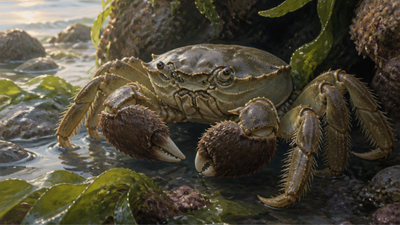
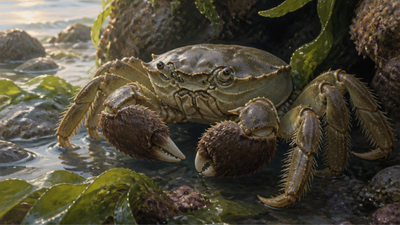
In the winter of 1992, a crew of shrimp trawlers working the waters of South San Francisco Bay pulled up their nets and found something that didn’t belong there.It wasn’t anything huge, but just a small creature wrapped in chaos!They found a fist-sized, brownish crab with dense, fur-like patches on its claws, as if it were wearing a pair of mittens. It was the first confirmed sighting of the Chinese mitten crab in the United States.Nobody at the time could have predicted what came next. Within a few years, the crab had multiplied by the hundreds of thousands, burrowed into levees, clogged water pumps, and become one of the most notorious invasive species on the West Coast.Let’s dig in to find out the story of the Mitten crabs, one of the mostv notorious species on the West Coast.
It all began quietly in the South San Francisco Bay
The Chinese mitten crab is native to the coastal rivers of China and South Korea, where it drains into the Yellow Sea. It most likely reached California as larvae riding in a ship’s ballast water, which is a common route for aquatic invaders. Once ashore, it found San Francisco Bay’s mix of fresh, brackish, and salty water, which was nearly an ideal substitute for the estuaries it left behind, according to the California Department of Fish and Wildlife.
From a single catch to a full-blown boom
By 1996, the crabs had pushed upstream into the Sacramento–San Joaquin Delta, and by 1998 they could be found everywhere from Colusa County in the north to Merced County in the south. Catches at water diversion facilities became more and more as their numbers increased, and nearly three-quarters of a million crabs were found in the North Bay alone that year, clogging fish-salvage screens and pumping equipment, according to the Smithsonian Environmental Research Center.
The Mitten Crab’s population suddenly stopped growing on the West Coast of the US
Almost as suddenly as it exploded, the Delta population crashed. Researchers rarely collect the crabs in the watershed today, and no live specimen had been confirmed in California since 2010, and this decline was “puzzling.” While the West Coast population quieted, the species was found then nearly 3,000 miles away, in Chesapeake Bay in 2005, Delaware Bay in 2007, and the Hudson River, where it has since been tracked as far inland as Albany.
Why this crab is so hard to keep out
Mitten crabs are catadromous, meaning they live in freshwater but must return to saltwater to breed, which helps them colonize entire river systems from a single coastal foothold. Their larvae drift widely on currents, adults can burrow tunnels half a meter into riverbanks, and by some accounts they can even climb structures over ten feet tall, per the U.S. Bureau of Reclamation. That combination of mobility, tolerance for polluted water, and burrowing capabilities makes established populations extraordinarily difficult to remove once they take hold.
A new front opens in the Pacific Northwest
In April 2025, a commercial fisherman working the Lower Columbia River near Tongue Point, Oregon, caught a mitten crab, the first confirmed sighting in the region, according to reports from the Oregon Department of Fish and Wildlife. A second crab was then found that November in the Willamette River near Portland, and 2025 marked the species’ first confirmed regional foothold, more than three decades after it first appeared in San Francisco Bay.