








Snakes are scary slitherers that not only have a frightening reputation but have also been revered as mythological creatures over centuries.And nature has created all these creatures in balanced numbers, but what happens when these venomous reptiles outnumber their prey?It creates an imbalance in the ecosystem.So, whenever nature gets out of balance, humans have turned to major tools like bounties, traps, satellites, and sometimes even genetic tests. But Florida came up with an unlikely idea that seems more like a solution from a children’s storybook than a science lab.
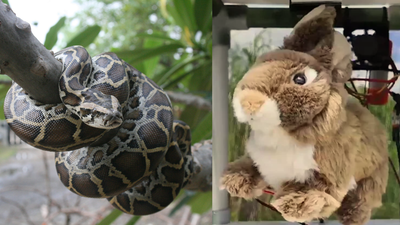
Fluffy rabbits are the cutest high-tech weapon to tackle Florida’s invasive Burmese pythons
Burmese pythons are not native to Florida. They were first spotted in the Everglades in the 1970s, brought in through the exotic pet trade. According to CBS News, officials say the snakes have wiped out 95% of small mammals in Everglades National Park. Due to their extremely tactical and clever hiding strategies, pythons hide extremely well, so finding them is half the battle.To look for a solution to this issue, University of Florida’s Department of Biology researchers removed the stuffing from toy bunnies and added motors, heaters, and solar panels to imitate marsh rabbit prey. The South Florida Water Management District (SFWMD) says the robots give off a heat signature and a smell, and their cameras alert officials when a python shows up.The lead researcher, Robert McCleery, told Popular Science the aim is to “capture all of the processes that an actual rabbit would give off”; apart from this, the robots can also produce vibrations, and their signals can be mixed and matched, and an AI system is being built to spot approaching pythons.
From pilot planning to field test
According to a Smithsonian Magazine report, the team began with 40 robotic rabbits in a pilot study, and later the water district and University of Florida deployed 120 robot rabbits as an experiment, and even though the officials estimated it to be too early to judge the results, the results were optimistic. NBC News puts the cost of the rabbits at about $4,000 for the real-looking rabbit robots in summer 2025.
How did this idea originate?
The idea comes from earlier research with live rabbits. In a 2024 study published in PeerJ, researchers used domesticated rabbits as lures and time-lapse cameras, recording 21 independent python detections at lure pens and just one at a pen without lures. The same paper found that cameras spotted almost 40 times more snakes than visual surveys did.Smithsonian Magazine says the live rabbits attracted nearly one python a week, but looking after them took a lot of effort. That is why the team began using the robots.A 2025 USGS-listed study, meanwhile, tested scent alone. It found no difference, and seven pythons were detected at soil controls and four at rabbit-scent plots, so the authors suggested a lure combining heat, sight and movement. That is exactly what the robots try to do.