









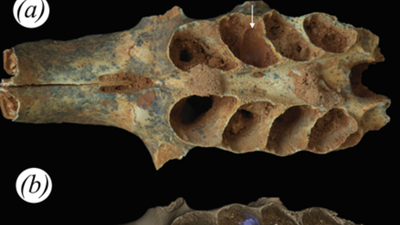
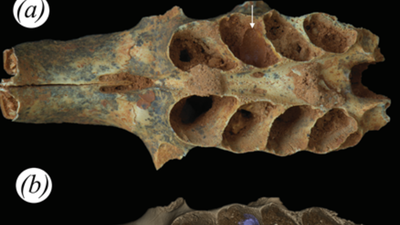
Paleontologists have found the first known evidence of bees nesting inside animal bones, using empty tooth sockets in fossilized jaws as nurseries for their eggs, according to a new study published in Royal Society Open Science in 2025.
The discovery that shouldn’t have been possible
The nests turned up in a limestone cave on Hispaniola, the Caribbean island shared by Haiti and the Dominican Republic, in jawbones that were roughly 20,000 years old. Lázaro Viñola López, a postdoctoral researcher at the Field Museum in Chicago and the study’s lead author, was going through bags of fossilized rodent and sloth jaws when he noticed something in the empty tooth sockets that didn’t match normal sediment buildup. It formed smooth, almost bowl-shaped surfaces instead of settling in randomly.“It was a smooth surface, and almost concave. That’s not how sediment normally fills in, and I kept seeing it in multiple specimens,” he said. “I was like, okay, there’s something weird here.”That instinct turned out to be right. He and his team eventually confirmed that solitary bees, the ones that live and nest alone rather than in hives, had tunneled into the cave’s soft, clay-rich dirt, run into fossilized jawbones, and simply moved into the empty tooth sockets instead of digging further. Each bee sealed its new home with the same waterproof lining solitary bees use to protect eggs in a normal underground burrow, then laid an egg inside.
Why this cave, and why now
The bones came from a deep sinkhole cave that served as a roost for generations of owls, possibly for hundreds or thousands of years. Owls swallow prey whole and later cough up what they can’t digest in tight bundles called pellets. Layer after layer of those pellets built up on the cave floor over centuries and slowly turned to stone, preserving bones from more than fifty species, including rodents, sloths, birds, and even turtles and crocodiles that likely fell into the sinkhole by accident.No actual bees were found in the nests. Insects don’t preserve well, especially in a warm, humid cave environment, so the soft-bodied evidence simply didn’t survive 20,000 years the way bone does. But the nests themselves were distinctive enough that researchers classified them as an entirely new type of trace fossil, meaning a fossil that records behavior rather than a body. They named it Osnidum almontei, after Juan Almonte Milan, the Dominican paleontologist who first identified the cave as scientifically significant.
A behavior nobody had seen before
More than 90 percent of bee species live solo rather than in colonies, and nearly all of them dig their nests straight into open soil. None had ever been documented repurposing a bone cavity instead, in the fossil record or among bees alive today. That’s what makes this such an unusual find, not just where the bees ended up, but that they adapted an existing structure at all rather than building one from scratch.“This discovery shows how weird bees can be, they can surprise you,” Viñola López said. “But it also shows that when you’re looking at fossils, you have to be very careful.”
What it adds up to
Limestone caves like this one are common across Hispaniola, and researchers suspect similar bee nests might already be sitting unnoticed in fossil collections dug up years ago, just never examined this closely. The jawbones in this study were originally collected to study the mammals the owls had eaten, not the insects that later moved in.So the real discovery here wasn’t really about the owls, or even about the bones themselves. It was about what happened to those bones long after the owls were done with them. A cave floor built entirely from centuries of leftover prey turned out to be hiding a second, much smaller story, one written by bees looking for the easiest available shelter, and finding it in a skull.