




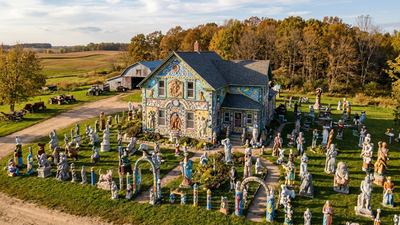
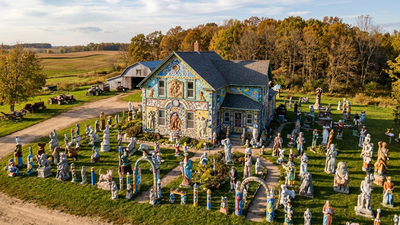
A sprained ankle changed the course of Nick Engelbert’s life on his small farm in Hollandale, Wisconsin. An Austrian immigrant who made his living as a dairy farmer, Engelbert began working with concrete and found objects, eventually turning his farmhouse and yard into an unusual collection of handmade art. Broken china, pieces of glass, buttons, beads and seashells became part of the surfaces he decorated, while the grounds gradually filled with figures drawn from American politics, folklore, history and his own imagination. What began with a single sculpture grew over the next 15 years into a display of more than 40 works, giving the property its own distinctive character.
How a sprained ankle inspired Nick Engelbert’s folk art
Nick Engelbert was born in Austria in 1881 and later settled in Wisconsin, where he worked as a dairy farmer. His home in Hollandale became known as Grandview, a name that reflected the broad views across the surrounding countryside. For years, the property served as his home and workplace, but a visit to the Dickeyville Grotto around 1930 introduced him to a different way of using concrete.The grotto, an elaborate assemblage of religious and decorative structures made with cement and colourful objects, appears to have left a lasting impression on Engelbert. He began adapting some of those ideas at home, although his own work would draw on a much wider range of subjects. A sprained ankle is associated with the beginning of his sculptural work, giving him a reason to turn his attention towards a project that did not depend on his usual farm duties.Engelbert started with concrete, gradually learning how to shape and decorate it. The work spread beyond a single object. His farmhouse became part of the undertaking, with the exterior covered in concrete and embedded fragments of china, glass, beads, buttons and shells. An arched porch framed the entrance, giving the building an appearance unlike that of a conventional rural home.
Nick Engelbert created more than 40 concrete sculptures to transform Grandview’s grounds
The changes to Grandview did not stop at the walls. Over roughly 15 years, Engelbert created more than 40 sculptures for the surrounding grounds, making use of the space around his house as an outdoor display. Some pieces drew on familiar symbols, while others reflected stories, historical figures and scenes that he devised himself.Eagles and castles featured among the works, alongside planters, a Viking aboard a ship and an organ grinder. Their subjects were varied, and the collection did not follow a single theme. Engelbert moved between patriotic imagery, fairy tales and mythology, using the same basic material to produce objects with different forms and meanings.The decorations also made use of materials that might otherwise have been discarded. Small pieces of glass and china, along with buttons and beads, were pressed into the concrete to add colour and detail. Rather than relying on paint alone, Engelbert built the decoration into the surfaces themselves. The result was a house and garden that shared a common visual style.
A sculpture that brought politics into the garden
Among Engelbert’s more pointed creations was a work titled How do you expect to get a day’s work out of a team like this. It depicted Uncle Sam attempting to plough with a donkey and an elephant, the animals associated with the Democratic and Republican parties in American politics.The joke depended on the contrast between the familiar image of a farmer working a team in a field and the political symbolism of the animals pulling the plough. It also reflected Engelbert’s interest in subjects beyond farm life. His sculptures could draw on national identity and public affairs just as readily as they could on legends or imagined characters.The political piece sat alongside works with no obvious connection to current events. A castle, a Viking ship and an organ grinder belonged to different worlds, yet all became part of the same garden. Engelbert’s approach allowed these subjects to coexist without the collection needing to tell one continuous story.
At 70, Nick Engelbert turned from concrete sculptures to painting
By the time Engelbert reached 70, he could no longer continue making sculptures. He turned instead to painting, producing more than 200 oil paintings during the final period of his life. The change brought a different working method, but it allowed him to keep making art after the physical demands of building large concrete figures had become harder to manage.Engelbert died in 1962, aged 80 or 81, depending on how his age is calculated from his birth year. His work at Grandview had developed over decades, beginning with changes to the farmhouse and expanding into a collection of sculptures that reflected his interests and imagination.
Grandview’s legacy as a Wisconsin folk art landmark
Engelbert’s property is remembered as an example of folk art created outside formal artistic institutions. He was a farmer rather than a trained sculptor, and his work developed through practical experimentation with concrete and decorative materials. The house itself became part of the display, while the sculptures brought together political humour, familiar stories and subjects from his imagination.The collection’s origins lay in a modest change of routine, but its scale grew through years of work. Engelbert transformed the setting around his home without abandoning the rural character of the property. His sculptures were not separate from everyday life on the farm; they occupied the same land where he had lived and worked.