








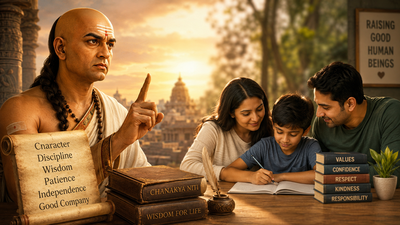
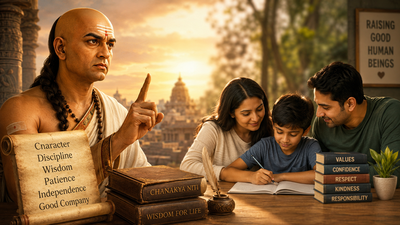
Every generation believes parenting has become more complicated than it was before. Today’s parents worry about screen time, social media, bullying, academic competition and the pressure to help children succeed in an increasingly demanding world. Advice comes from everywhere, from parenting books and psychologists to podcasts and Instagram reels. Yet despite all the new challenges, one truth has remained remarkably constant: raising a child has never simply been about preparing them for exams or careers. It has always been about preparing them for life. More than two thousand years ago, Chanakya was writing about leadership, education, discipline and human behaviour. While many of his ideas belonged to the realities of his era and should be viewed in their historical context, several of his broader observations still feel strikingly relevant. They are less about strict rules and more about understanding how character is shaped over time. Here are some of Chanakya’s lessons that continue to resonate with modern parenting.
Character matters long after report cards are forgotten
29 Jun 2026 | 15:40
After the Siya Goyal case, Kangana Ranaut argued that parents shouldn’t automatically be blamed. What’s your take?
Every parent wants their child to do well in school. Good grades create opportunities, and hard work deserves encouragement. But Chanakya believed knowledge without character was incomplete, and it is a lesson that feels especially important today.Years after school ends, few people remember who topped every examination. They do remember who kept their word, admitted mistakes, treated others with respect and stood by friends during difficult times. These qualities rarely appear on a report card, yet they often shape a person’s future more than academic success alone. Parents who celebrate honesty, kindness and responsibility alongside achievement help children understand that success is about far more than marks.
Discipline works best when it teaches, not when it frightens
Children naturally test limits. They forget homework, argue with siblings, break rules and sometimes make choices that leave parents wondering what happened to all the advice they have given.Chanakya believed discipline was necessary, but modern parenting has expanded that idea in an important way. Children learn more from guidance than fear. A calm conversation after a mistake often stays with them far longer than shouting in anger. Boundaries still matter, but when children understand why a rule exists instead of simply fearing punishment, they are more likely to develop self-discipline rather than obedience alone.
Curiosity is one of the greatest gifts a parent can protect
Chanakya viewed education as a lifelong treasure because it could never truly be taken away. That wisdom extends beyond classrooms and examinations.

Young children are naturally curious. They ask endless questions, take things apart and wonder how the world works. Somewhere along the way, many begin to believe learning exists only for tests. Parents can gently change that by encouraging questions, visiting museums, reading together or simply allowing children to explore ideas without worrying about getting every answer right. A child who enjoys learning is often better prepared for life’s uncertainties than one who studies only to score well.
The people children spend time with shape them more than parents realise
Every parent eventually reaches the stage where friends begin influencing a child almost as much as family does. Chanakya repeatedly warned that the company we keep quietly shapes our thinking, habits and decisions.Today, that influence extends beyond neighbourhood friends to online communities, gaming groups and social media. Parents cannot choose every friendship, nor should they try. What they can do is teach children how healthy relationships feel. Friends who encourage kindness, honesty and confidence deserve a place in their lives. Those who constantly pressure, manipulate or belittle them usually do not.
Children learn far more from watching than listening
Parents often remind children to be polite, honest and patient. The challenge is that children are usually paying closer attention to behaviour than words.If they regularly see adults speaking respectfully to helpers, apologising after mistakes, keeping promises and treating people fairly, those lessons quietly become normal. On the other hand, children also notice when actions contradict advice. Chanakya understood that leadership begins with example, and parenting is perhaps the clearest example of that principle. The values parents practise every day often become the values children carry into adulthood.
Protect children, but do not remove every obstacle
Wanting to make life easier for children is natural. Every parent hopes to spare them disappointment, failure and heartbreak. Yet children who never face challenges often struggle when life eventually becomes unpredictable.

Chanakya believed resilience grows through experience. Modern psychology echoes a similar idea. Whether it is losing a competition, resolving a disagreement with classmates or learning from failure in an exam, small setbacks teach children that disappointment is not the end of the story. Parents who support rather than rescue at every step often raise children who trust themselves to overcome difficulties.
Teach patience in a world that promises everything instantly
Today’s children are growing up in an age where food, entertainment and information arrive within minutes. Waiting has become increasingly rare.Chanakya repeatedly praised patience and thoughtful decision-making. While technology has changed dramatically, human nature has not. Children still benefit from learning that meaningful achievements take time. Saving for something instead of buying it immediately, practising a skill until it improves or working steadily towards a goal teaches a lesson that instant gratification never can. Patience is not simply about waiting; it is about learning that worthwhile things usually require effort.
Raise independent adults, not dependent children
Perhaps one of the most enduring lessons from Chanakya’s philosophy is that the ultimate goal of guidance is independence.

Parents naturally become deeply involved in their children’s lives, especially during the early years. But as children grow, so should their ability to make decisions, solve problems and accept responsibility for the consequences. Packing their own school bag, managing pocket money, speaking respectfully for themselves or learning basic household responsibilities may seem like small tasks, yet they quietly build confidence. Independence does not happen suddenly at adulthood. It develops through hundreds of ordinary moments in childhood.Chanakya lived in a world very different from ours, and not every idea associated with him fits comfortably within modern parenting. Yet many of his broader principles continue to hold value because they focus on something timeless: building character rather than chasing perfection. Children will eventually forget many of the lectures they heard growing up. What often stays with them are the habits they learned, the examples they witnessed and the values they saw practised every day. In the end, that may be the most lasting lesson of all, not just from Chanakya, but from every generation that has tried to raise good human beings.