









The Texas Court of Appeals has upheld a nursing facility’s liability in a lawsuit filed by a nursing aide who was injured while helping a patient weighing more than 300 pounds move from a bed to a wheelchair. However, it has proposed reducing the $500,000 awarded for her future medical expenses by $264,448.51.The ruling, delivered by the Fourteenth Court of Appeals on November 5, comes nearly 10 years after the May 2016 incident. The court upheld the jury’s finding that Red Bluff LLC was negligent and that its actions caused the aide’s injuries.The jury awarded Nicole Tarpley $7.11 million for medical expenses, physical pain, mental anguish and physical impairment. The appeals court upheld most of the award but said the evidence supported only $235,551.49 in future medical expenses.Tarpley has 20 days to accept the proposed reduction. Otherwise, the case will return to the trial court for a new trial on liability and damages.
Nursing aide received only one day of floor training
Red Bluff operates a nursing and rehabilitation facility in Pasadena, Texas. It hired Tarpley as a certified nursing assistant (CNA) in April 2016. She had five years of experience but had worked at the facility for only three weeks when the accident happened.The facility’s assistant director of nursing, Lisa Kemp, said new CNAs were supposed to receive two days of general training and three days of floor training while shadowing a nurse. Tarpley received only one day of floor training before being told she was “ready”.During her training, Tarpley was instructed that a resident identified as Tom, who weighed more than 300 pounds, needed only one person to help him move from his bed to a wheelchair.
Patient fell during wheelchair transfer
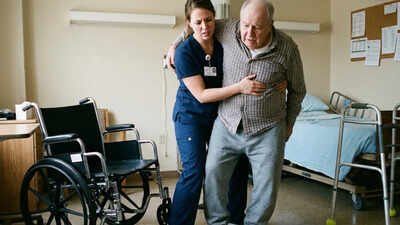
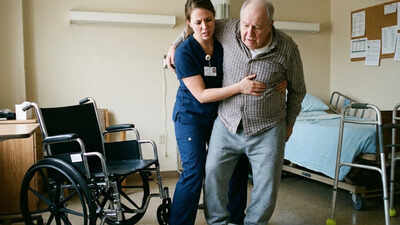
On May 5, 2016, Tom asked Tarpley to help him move from his room to the library. She placed a walker beside his bed and positioned a wheelchair next to it, locking its brakes.Tom stood up holding the walker while Tarpley steadied him with one hand and held the wheelchair with the other. Although she checked the brakes again, the wheelchair moved when they unexpectedly disengaged.As Tom began falling, Tarpley tried to support him with her leg. Her knee hyperextended, and her body twisted as they both fell. She heard a “clack” in her knee but continued working after seeking help.Kemp later testified that Tom required at least two employees for transfers because of his weight and the risk of falling. She said she would not have attempted to move him without assistance.Red Bluff’s corporate representative, Adeyemi Alabi-Isama, also said a CNA should not have attempted the transfer alone without additional training from a physical therapist.
Court finds facility failed to provide adequate training
Tarpley’s expert, registered nurse and CNA instructor Donna Raley, testified that the aide had not been properly trained. She said Red Bluff had failed to provide adequate instructions on transferring residents, particularly Tom.Red Bluff argued that Tarpley had five years of CNA experience and should have understood the risks of moving a patient weighing more than 300 pounds without assistance.The appeals court disagreed, noting that transferring patients, particularly heavy ones, involved procedures requiring specific knowledge and training.It also pointed out that Red Bluff had instructed Tarpley on how to move Tom. Having undertaken to provide the training, the facility had a duty to ensure its instructions were adequate.The court found sufficient evidence that Red Bluff had failed to exercise ordinary care in training Tarpley. It upheld the jury’s negligence finding and said there was no need to examine the separate premises-liability finding.
Court cuts future medical expenses
The appeals court separately examined the $500,000 awarded for future medical expenses. Tarpley suffered injuries to her knee, neck and lower back. She developed herniated discs and eventually underwent discectomy and fusion surgery at two levels in her neck.Her surgeon, Dr Henry Small, testified that she would need another operation on an adjacent level of her neck. He estimated its cost at $235,551.49, the same as her first surgery.For her lower back, the doctor recommended a spinal cord stimulator. However, Tarpley presented no evidence of its likely cost.The court therefore found evidence supporting future medical expenses of $235,551.49, but not the full $500,000 awarded by the jury. It proposed reducing the award by $264,448.51.
Court upholds physical impairment awards
Red Bluff also challenged the jury’s awards of $750,000 for past physical impairment and $2 million for future physical impairment. The appeals court rejected the challenge.Tarpley told the court that her knee continued to “click and pop” and that she could no longer walk as she did before the accident. She also described persistent back pain, neck pain and migraines.She said she could no longer lift or play with her children or go camping with them. Although surgery improved her neck condition, her range of motion remained about 60% of what it was before the accident.Her injuries also affected activities she shared with her husband, including antiquing and restoring furniture. She could no longer stand for long periods or lift furniture.Her husband was later diagnosed with terminal stage 4 lung cancer, which spread to his bones and left him wheelchair-bound. Tarpley said she could not lift him into his wheelchair or help him bathe.The court said her testimony showed that the injuries had affected her daily activities and hobbies beyond physical pain and mental anguish. It upheld both physical impairment awards.