







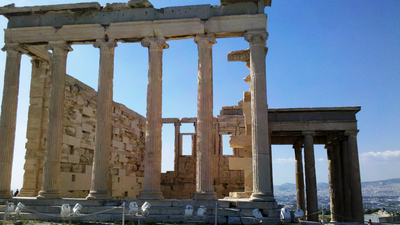
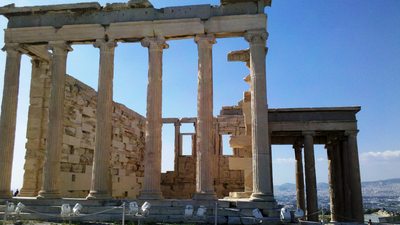
We often encounter history in the most unusual ways, without even realising to have come across one of those pieces hidden in plain sight.One such incident happened when a small piece of carved marble sat on a dining room shelf in Chile for decades, and its owner told visitors it was a fragment of the Parthenon, the historic landmark in Greece, only to discover that the piece most likely came from the Hekatompedon, an Acropolis temple built around 570 BCE, more than a century before the Parthenon.So how did a family souvenir turn out to be older than the monument it was named after?A generation family heirloom placed at a shelf for generations turms out to be an 100 year older part of the temple before Greece’s PartheonThe story begins in 1930, when Gaetano Tosti-Croce, an Italian submarine engineer, visited Athens with the Italian Navy and picked up a small piece of carved marble near the base of the Parthenon. During World War II, he served as chief engineer on the Italian submarine Console Generale Liuzzi.British destroyers sank the vessel in June 1940, and spent the rest of the war as a prisoner of the British in India, according to The Art Newspaper. When the war ended, he moved to Chile with his family.
The family kept it as a sovernier on the shelf for years
Croce kept it as a keepsake, when after the war, his family settled in Viña del Mar, Chile, the stone went with them.According to Smithsonian magazine, the fragment was just over two and a half pounds, about three inches tall and four and a half inches wide, carved with part of a lotus flower. The family kept it in their Chile home on the dining room shelf. His son Enrico told the Spanish newspaper El País that it was “just another ornament”.Enrico inherited the piece when his parents died in 1994 and later took it to his home in Villarrica. He told first-time visitors it came from the Parthenon, and, as he told The Art Newspaper, some believed him and others did not.
The radio report that changed it all
Things changed when he heard a radio report about Greece’s long campaign to get the Parthenon sculptures back from the British Museum. He emailed the Greek Embassy in Chile in January 2025, sent photos and details to the deputy chief of mission.Then came the surprise. Months later, Olympia Vikatou, director of the Greek Archaeological Service, wrote to thank him. She explained that archaeologists believe the piece was probably part of a cistern or gutter on the Hekatompedon, the Acropolis’s oldest monumental temple, built around 570 BCE. That is well over a century before work on the Parthenon began.Greek specialists then studied the fragment. A letter from the Hellenic Ministry of Culture, cited by The Art Newspaper, said it was probably part of the roof gutter of an old temple called the Hekatompedon. That was the first grand temple on the Acropolis, built in the early 6th century BCE, more than a hundred years before work on the Parthenon began. Tosti-Croce said the piece “wasn’t from the Parthenon, but from an even older temple”, adding : “I felt like I had done something good.“