









Planning for retirement often gets pushed aside when people are still in their 20s or 30s. But for those without a formal employer-sponsored pension, even a small contribution made regularly over several years can help create a source of income in old age.One government-backed option is the Atal Pension Yojana (APY), a voluntary pension scheme administered by the Pension Fund Regulatory and Development Authority (PFRDA). The scheme offers a guaranteed minimum monthly pension of ₹1,000, ₹2,000, ₹3,000, ₹4,000 or ₹5,000 from the age of 60, depending on the pension option chosen and contributions made.But there is an important eligibility condition that many people may overlook: a person who is or has been an income-tax payer cannot open a new APY account from October 1, 2022. Existing subscribers who joined on or before September 30, 2022, can continue with their accounts.
What is Atal Pension Yojana?
The Atal Pension Yojana was introduced by the Government of India in 2015, with a particular focus on workers in the unorganised sector and people who may not have access to a formal pension system.The scheme works on a simple principle: a subscriber contributes regularly until the age of 60 and, in return, receives a government-guaranteed minimum pension after turning 60. The amount depends on the pension slab selected at the time of joining.The five available pension choices are:
- ₹1,000 per month
- ₹2,000 per month
- ₹3,000 per month
- ₹4,000 per month
- ₹5,000 per month
The pension continues for the subscriber’s lifetime.There is also a benefit for the spouse. After the subscriber dies, the spouse is entitled to receive the same pension amount until the spouse’s death. After both the subscriber and spouse die, the pension wealth accumulated under the scheme is returned to the nominee.
Who is eligible for APY?
The basic eligibility rules are fairly straightforward.A person must:
- Be an Indian citizen
- Be between 18 and 40 years of age
- Have a savings bank account or a post office savings bank account
- Not be an income-tax payer at the time of opening a new APY account
The government specifically clarified that from October 1, 2022, an individual who is or has been an income-tax payer under the Income-tax Act, 1961, is not eligible to open a new APY account.However, becoming an income-tax payer after joining the scheme does not automatically disqualify the subscriber. PFRDA says such a subscriber can continue the APY account and make contributions.There is another useful point: eligibility is not restricted only to people working in the unorganised sector. Government employees, public-sector employees and existing NPS subscribers can also join APY if they meet the scheme’s eligibility conditions. An NRI can also open an APY account if the prescribed eligibility conditions are met, according to PFRDA.
How much does APY cost?
There is no fixed annual contribution for Atal Pension Yojana. The amount a subscriber has to contribute depends on their age when they join the scheme and the monthly pension they choose. Contributions can be made monthly, quarterly or half-yearly.For example, if a person joins at 18 and chooses the maximum guaranteed pension of ₹5,000 a month, the prescribed monthly contribution is ₹210. That works out to about ₹2,520 a year if paid monthly.If the same person chooses a ₹1,000 monthly pension, the contribution is ₹42 a month, or about ₹504 a year. The contribution rises as the entry age increases because there is less time left until the pension begins.For someone joining at 40, the monthly contribution for the ₹5,000 pension option is ₹1,454. That is equivalent to about ₹17,448 a year when paid monthly. For the ₹1,000 pension option, the monthly contribution at age 40 is ₹291, or about ₹3,492 a year.The official contribution figures include:At age 18:₹42/month for ₹1,000 pension — ₹504/year₹84/month for ₹2,000 pension — ₹1,008/year₹126/month for ₹3,000 pension — ₹1,512/year₹168/month for ₹4,000 pension — ₹2,016/year₹210/month for ₹5,000 pension — ₹2,520/yearAt age 30:₹116/month for ₹1,000 pension — ₹1,392/year₹231/month for ₹2,000 pension — ₹2,772/year₹347/month for ₹3,000 pension — ₹4,164/year₹462/month for ₹4,000 pension — ₹5,544/year₹577/month for ₹5,000 pension — ₹6,924/yearAt age 40:₹291/month for ₹1,000 pension — ₹3,492/year₹582/month for ₹2,000 pension — ₹6,984/year₹873/month for ₹3,000 pension — ₹10,476/year₹1,164/month for ₹4,000 pension — ₹13,968/year₹1,454/month for ₹5,000 pension — ₹17,448/yearThese annual figures are simply the official monthly contribution multiplied by 12; the government also permits quarterly and half-yearly contribution frequencies.
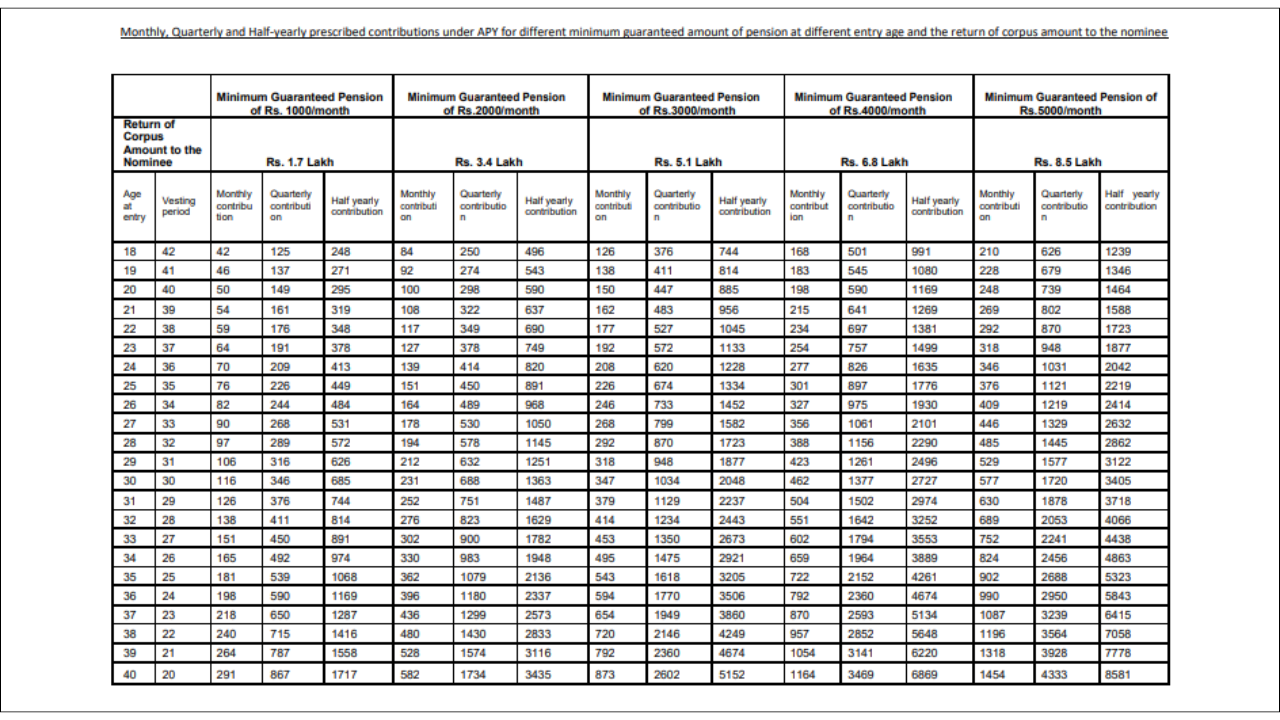
Official APY document lists the five guaranteed monthly pension options.
Why joining early matters
The contribution difference between an 18-year-old and someone joining at 40 is significant.For the ₹5,000 pension option, an 18-year-old contributes ₹210 a month, while a 40-year-old has to contribute ₹1,454 a month. The reason is straightforward: the younger subscriber has a much longer contribution period before reaching 60.The official APY contribution chart shows that an 18-year-old opting for the ₹5,000 pension contributes for 42 years, whereas someone joining at 40 contributes for 20 years. This is why PFRDA advises individuals to join APY as early as possible, provided they meet the eligibility conditions.
What happens after the subscriber dies?
APY is structured to provide benefits beyond the subscriber’s lifetime. After the subscriber’s death, the spouse receives the same guaranteed pension amount. After the death of both the subscriber and spouse, the nominee receives the pension wealth accumulated till the subscriber’s age of 60.The official APY contribution chart specifies the indicative return corpus for the five pension options as ₹1.7 lakh, ₹3.4 lakh, ₹5.1 lakh, ₹6.8 lakh and ₹8.5 lakh respectively.
How to open an APY account?
An eligible individual can approach the bank branch or post office where their savings account is held and submit the APY registration form. The PFRDA website also provides an online eAPY facility for eligible subscribers (https://pfrda.org.in/web/pfrda/schemes/atal-pension-yojana-apy).The contribution is subsequently auto-debited from the linked savings or post office account according to the frequency selected by the subscriber.An individual can have only one APY account. However, eligible family members between 18 and 40 can each have their own separate APY account.
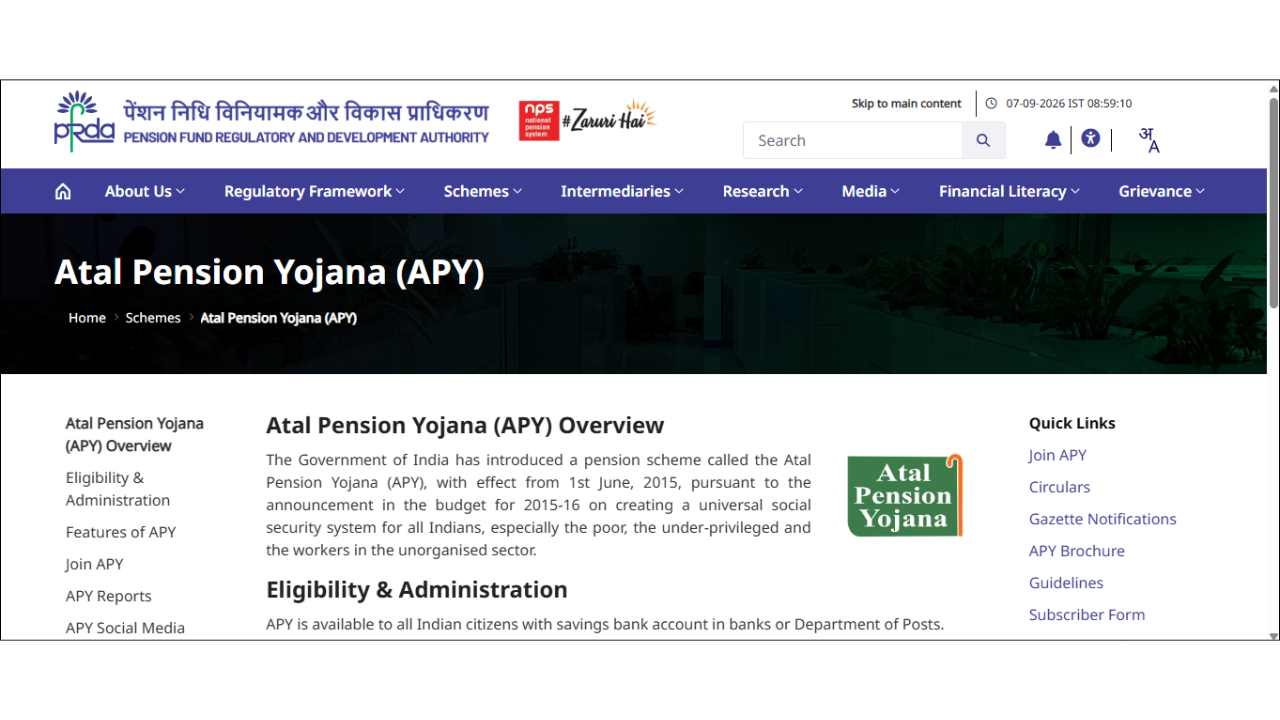
Screengrab of the official Government of India page for Atal Pension Yojana (APY).
The important point to remember
Atal Pension Yojana is not a scheme where everyone pays the same amount every year. The contribution is linked to the subscriber’s age at entry and the pension amount selected.Prospective subscribers should remember that the maximum guaranteed pension under APY is ₹5,000 a month, so it should be viewed as one component of retirement planning rather than necessarily a complete retirement-income solution.References from official government sources:https://pfrda.org.in/web/pfrda/schemes/atal-pension-yojana-apyhttps://www.pfrda.org.in/hi/w/faqs/atal-pension-yojanahttps://jansuraksha.gov.in/Files/APY/ENGLISH/APY.pdfhttps://www.pfrda.org.in/schemes/atal-pension-yojana-apy/apy-gazette-notificationsDisclaimer: This article is for general information. Readers should verify their eligibility and applicable contribution amount with their bank/post office or through the official PFRDA/Jan Suraksha portals before enrolling.