









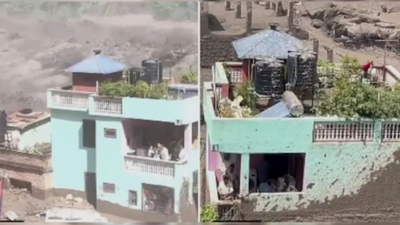
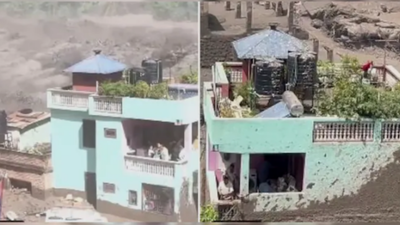
Nepal is going through one of the worst natural disasters, where flash floods triggered by an iceberg collapse have torn through the Himalayan nation, killing over 700 people and leaving thousands more missing.Entire villages have been wiped off the map, with rivers of mud, boulders, and uprooted trees crushing everything in their path. Amid this scale of destruction, a mint-green, two-storey home stood nearly untouched while the floodwaters around it swallowed neighbouring structures completely.Several videos have gone viral, showing a family huddled on the balcony, watching the chaos, as the house continues to relentlessly hold on to its base firmly beneath them.But how did the house manage to hold on despite everything around it having collapsed into rubble?
What does the video show?
The video shows the turquoise house standing amid a sea of muddy water laden with debris, broken walls, and vehicles, while three people watch anxiously from the balcony of the home. Even though floodwaters gushed through the ground floor of the house, they managed to rip off only doors and windows without causing any severe structural damage.While most people would call it sheer luck or some divine intervention, it is actually because of smart engineering that the house did not sway away into the muddy waters.
The smart engineering that saved the house from getting carried away into the floodwaters
An explanation from the X account Architecture Presentation gives a technical answer. According to this analysis, most homes in Nepal’s Himalayan valleys are built using stone masonry without a reinforced concrete frame. Such structures can typically bear weight pushing straight down on them, but they are far more vulnerable to sideways force, which is the kind of force that a wall of water and debris generates, and tend to buckle inward when hit from the side.This ‘green house’, however, was different, as the building had a reinforced-concrete frame in which “continuous steel rebar tied the columns, beams, and foundation together into a single, rigid skeleton.” This meant that when the debris flow struck, the frame could absorb the lateral force and channel it down to the foundation, rather than letting individual walls take the full impact and collapse.
Another factor that helped the house survive the tragedy
The same explanation concluded that the house was located away from the main channel of the floodwaters, so it escaped the deepest and most forceful part of the current, while surrounding debris and mud built up around it and helped redirect later surges away from the structure.