







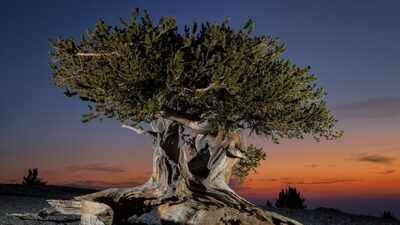
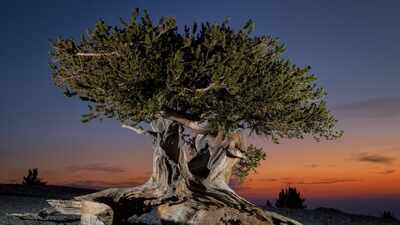
Some trees outlast entire time. There are trees that are older than buildings, older than cities, and even older than some of the civilizations we now study in history books. Then there is Methuselah, a Great Basin bristlecone pine in California that has been growing for roughly 4,850 years!Wrap your mind around that: when the first Egyptian pyramids started rising from the sand, Methuselah was already deep into its first millennium. It’s weathered droughts, fire, snow, empires, and the birth (and collapse) of cultures we now study in school. And, it’s still out there, standing quiet in the wind.
A tree as ancient as history itself
Per History, back in the 1950s, Edmund Schulman went looking for living history. Schulman, who helped pioneer dendrochronology, which is the science of reading tree rings as time written into wood, is the reason Methuselah’s story even got out. His work not only proved just how long-lived some bristlecone pines are, but also transformed the way scientists track centuries of environmental change. If you know how radiocarbon dating works, you have Schulman’s bristlecones to thank for helping calibrate it. But here’s the twist: if you want to see Methuselah for yourself, you can visit its forest, but you’ll never know which tree it is. Its exact identity is kept secret by the US Forest Service: it’s not marked, named, or pointed out. After nearly five thousand years, Methuselah gets to keep its privacy.
So, why do these trees last this long?
It’s chemistry and a bit of attitude. Bristlecone pines (species Pinus longaeva) aren’t just any trees. They like life on the edge: harsh, dry, windswept mountains where most things simply give up. That’s their trick. These conditions slow their growth to a crawl, but in return, you get dense, rot-resistant wood. Insects and fungus don’t stand a chance. After a couple thousand years, their trunks twist up into whatever shape time and weather dictate: ancient, almost ghostly sculptures with more dead wood than living tissue. To survive, Methuselah only needs one thin ribbon of living bark left; the other 99 percent of its trunk can be hollow or dead, but as long as that sliver pulls water and sunlight in, these trees keep going.Schulman recognized gold when he saw it. He started pulling records out of the bristlecone rings in the 1950s, eventually piecing together timelines that outstripped anything scientists had used before. Each tiny ring recorded a year’s worth of weather, rainfall, even volcanic eruptions. More than just living history, bristlecones became living laboratories. Their timelines help adjust radiocarbon tests, making our dating of ancient artifacts and fossils more accurate.Now, you might think a tree that old would be robust and green, but Methuselah looks more like driftwood planted among sharp, pale rocks. Decay and time shape its trunk into something that looks both defiant and vulnerable, which hardly resembles the image of a “world’s oldest tree.” But that’s its secret. Its harsh environment means no one else wants the real estate, so the tree persists. Every year, a sliver of life pushes new growth another millimeter, and, for five millennia, that’s been enough. In fact, the rough bark, missing limbs and almost haunted silhouette protect it as much as the remoteness does; tourists wouldn’t know it if they walked straight past.Want to hike near Methuselah?Good luck guessing which tree it is. The Ancient Bristlecone Pine Forest is open, and you’ll find signs for the Methuselah Grove, but that’s it. No arrows, no fences, no “world’s oldest tree here” markers. Carvings, too many feet, a single careless visitor; any of that could ruin a life that’s already outlasted Stonehenge and Rome. So, the rangers just don’t say. Over the decades, photos and rumors have circulated, but officially, Methuselah stays anonymous, blending in with its tough, persistent neighbors.Maybe the most moving part of Methuselah’s story, though, is what it tells us now. The bristlecones are used to surviving at the margins, but even they’re not immune to what’s happening in our world. Droughts are worse, wildfires move into new altitudes (in 2025, one nearly torched their forest), and the rules of the mountains keep shifting as climate change intensifies. Here’s this tree, tougher and more patient than any monument, suddenly vulnerable in ways it never had to worry about before.So, if you wander through the Methuselah Grove, stare at every twist and ancient bough, and wonder which is “the one,” you’ll leave not knowing. But that’s the poetry of it. Methuselah is real, but it’s also a symbol. It’s a witness to five thousand years of storms, droughts, random luck, and quiet persistence. It’s earned its mystery, and after all this time, maybe that’s a more fitting reward than a signpost. After all, secrets, like old trees, are sometimes worth protecting.