









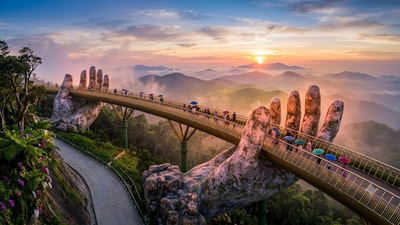
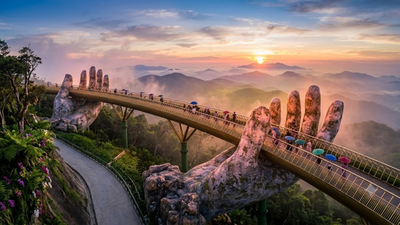
Perched high above the forests of central Vietnam, the Golden Bridge appears to float through the clouds, supported by two enormous stone hands emerging from the mountainside. Since opening in 2018, the striking structure has become one of the country’s most photographed landmarks, drawing visitors from around the world. While the hands look like ancient rock formations weathered over centuries, they are, in fact, a carefully crafted architectural illusion designed to blend seamlessly with the surrounding landscape. Stretching across the Bà Nà Hills near Da Nang, the bridge is more than a scenic walkway. It demonstrates how engineering, architecture and nature can work together to create an experience that feels both dramatic and harmonious, redefining the relationship between built structures and the natural environment.
Why does Vietnam’s Golden Bridge look like it is held up by giant hands?
The bridge’s most distinctive feature is its pair of colossal stone hands, which appear to lift the golden walkway above the forest canopy. Although they resemble weathered rock carved by nature, the hands are reinforced architectural structures built using steel frameworks covered with fibreglass and carefully finished to imitate aged stone.Designed by Archdaily, the illusion was intended to evoke the image of a giant mountain deity gently supporting the bridge. Rather than competing with the surrounding scenery, the design creates the impression that the structure has emerged naturally from the landscape, blurring the boundary between architecture and nature.
How does the Golden Bridge combine engineering with the mountain landscape?
According to Hanoi Day Trip, located approximately 1,414 meters (approx 4,600 ft) above sea level in the Bà Nà Hills, the Golden Bridge spans about 150 meters (approx 490 ft) across the mountainside. Engineers designed the gently curving pedestrian bridge to follow the natural contours of the terrain while providing uninterrupted panoramic views of the surrounding forests and valleys.The structure is supported by concealed foundations and piers, allowing the giant hands to appear as though they bear the bridge’s weight. This visual trick demonstrates how modern structural engineering can create the illusion of impossible architecture without compromising safety or stability.The bridge also forms part of a wider mountain resort connected by one of the world’s longest non-stop cable car systems, enabling visitors to reach the summit while minimising disturbance to the surrounding landscape.
Why has the Golden Bridge become a global architectural icon?
Soon after opening, the Golden Bridge attracted worldwide attention for its imaginative design, quickly becoming one of Vietnam’s most recognisable landmarks. Unlike many observation bridges that prioritise height alone, its appeal lies in the way it transforms a simple pedestrian walkway into an immersive artistic experience.Architects increasingly use landmark structures to strengthen the identity of destinations while encouraging sustainable tourism. The Golden Bridge demonstrates how bold design can coexist with natural scenery rather than dominate it, creating a visual experience that is both memorable and respectful of its setting.Its popularity has also highlighted Vietnam’s growing reputation for contemporary architecture, where innovative public spaces increasingly draw as much attention as the country’s historic temples, coastlines and cultural heritage.
How do high-altitude environments influence architectural design?
Designing structures at high elevations presents challenges that differ significantly from those at ground level. Engineers must account for stronger winds, frequent mist, rapid weather changes and the long-term effects of moisture on construction materials. Every element, from structural supports to surface finishes, is carefully selected to ensure durability while preserving the intended visual effect.According to the American Society of Civil Engineers (ASCE), climate, terrain and environmental exposure are among the most important considerations in mountain engineering. At Bà Nà Hills, these factors influenced not only the bridge’s structural design but also the choice of materials that allow the giant hands to retain their weathered appearance despite constant exposure to the elements.The result is a structure that is as much an engineering achievement as it is a work of public art, showing how thoughtful design can transform a challenging mountain landscape into one of the world’s most distinctive architectural destinations.