









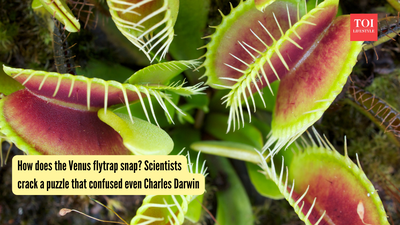
Some of nature’s best tricks happen too fast for the human eye to follow. A chameleon’s tongue, a mantis shrimp’s punch, a hummingbird’s wingbeat, by the time we even register the movement, it is already over.Something similar happens with the Venus flytrap that snaps its favourite meals, insects, with its bright, green coloured jaw like leaves.But how does something fixed in one spot react quickly enough to trap a fly mid-step, and that too, without any animal actually touching it?A new team of researchers might just have the answer to what exactly happens in that split second.
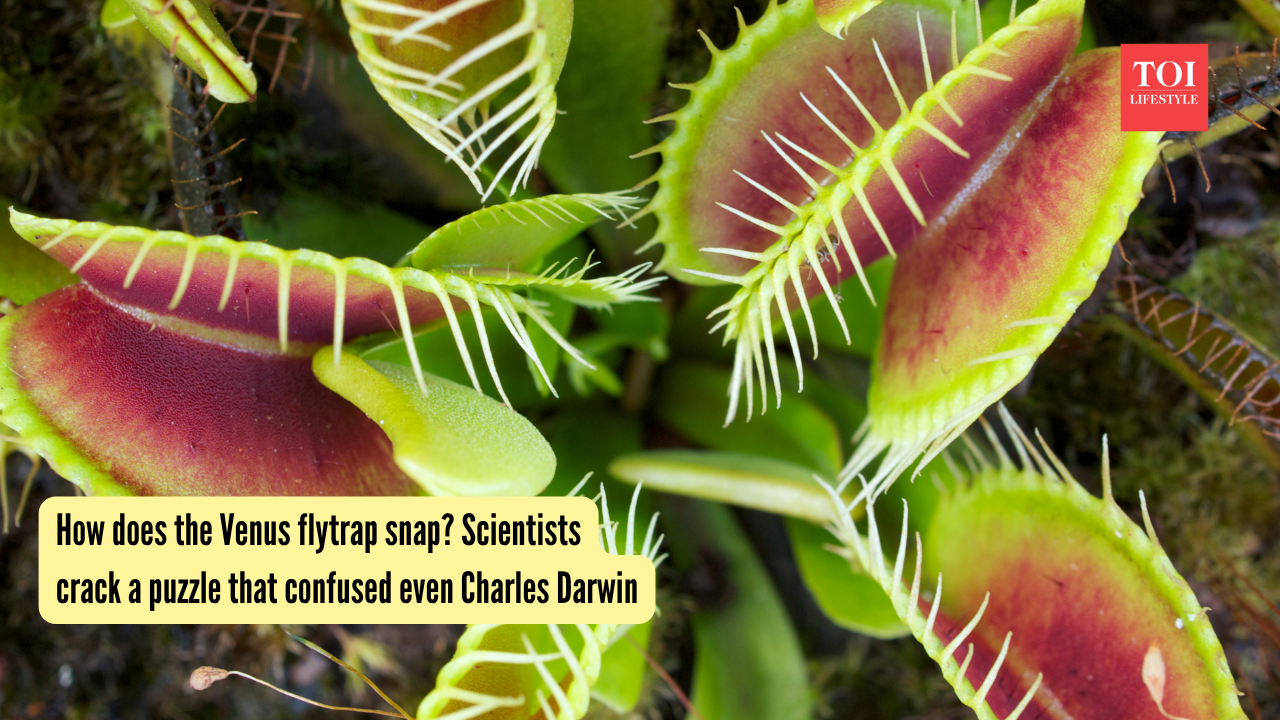
Representataive Image
Venus flytrap: the predator that puzzled Charles Darwin
The Venus flytrap lures insects with a sweet, nectar-like scent, then slams its hinged, jaw-like leaves shut within a second of a bug touching down. That speed has baffled scientists for more than a century.When Charles Darwin studied the plant, he was convinced some hidden muscle had to be driving the motion. But as senior author Dr Yoël Forterre, a physicist at France’s CNRS and Aix-Marseille University, points out, plants have neither muscles nor nerves, which left the real mechanism a stubborn, long-standing puzzle that outlived Darwin and many who came after him.
What did researchers find?
As Forterre says, the slightest disturbance sets it off, and once triggered, it stays shut for days while it digests. To get clean readings, the team immobilised the leaves using dental glue, so a trap could be triggered without actually moving. They then used a nanoindenter, a fine metal tip, to gently poke the leaf’s outer surface and measure its stiffness. Forterre checked the sensation of pressing a finger against a balloon to feel how taut it is.
The measurements revealed something unexpected
The instant the trap was activated, the outer surface of the leaf softened noticeably, with its cell walls becoming roughly 30 to 40% more flexible, according to the study published in the journal Science. Crucially, mapping the leaf’s surface showed the cells were genuinely turning softer, not merely deflating as water drained out of them. That finding stands contrary to the long-favoured theory that closure was due to water rushing from one side of the leaf to the other to swell it.
So how does softening produce a snap?
The researchers suggest the open trap is already under tension, mechanically loaded like a pre-compressed spring. When the trigger hairs fire, sending an electrical signal across both lobes in about a tenth of a second, the sudden softening releases that stored stress, and the leaf flips shut. Forterre compares it to a dome-shaped rubber popper toy that sits quietly, then springs inside out on its own. The whole softening process completes within roughly one second.
Twenty years chasing a one-second movement
For Forterre, this is the reward for a long obsession that began when a former colleague carried a flytrap into his lab. As a physicist, he wanted to understand the forces and the “motor” behind the motion, and he says he has been gripped by the question for twenty years.He knows of no other plant that can change the mechanical properties of its cells so rapidly.